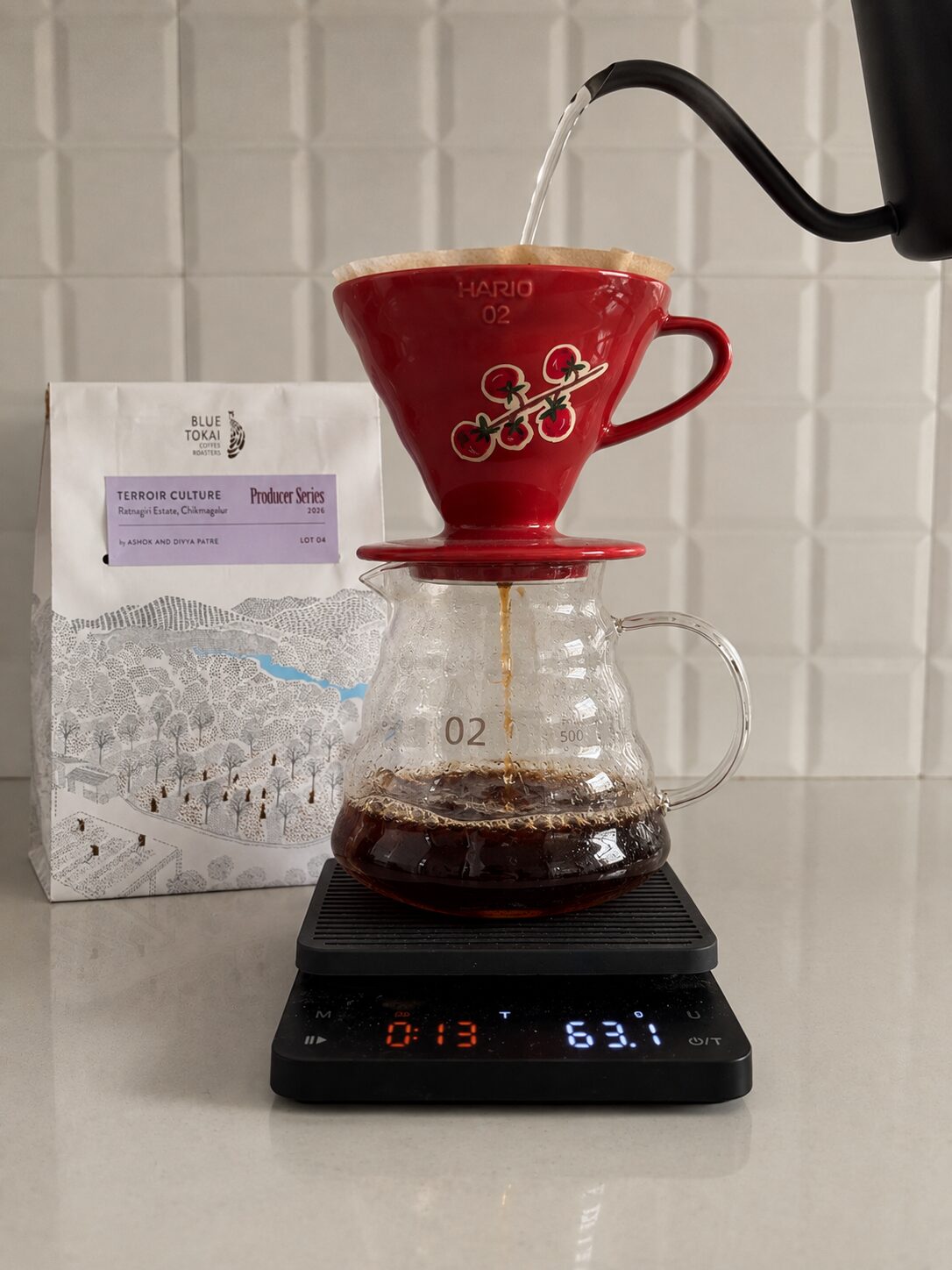
Some bags of coffee show up and quietly reorder your week. This one has been sitting in my kitchen for six days now — the whole time I've been putting off buying anything else, because opening another bag felt like being rude to it.
It's a Blue Tokai release from their Producer Series — a lot from Ratnagiri Estate in Chikmagalur, grown at somewhere between 1,300 and 1,350 metres, SLN 9 Arabica under the deep shade the estate is known for. On the front of the bag it says Terroir Culture, and I want to spend a minute on that, because it's the thing that made me buy it in the first place.
Terroir — the unique mix of a place's soil, climate, elevation, and even its flora and fauna, influences how a coffee grows and tastes. At Ratnagiri, that sense of place goes a step further. The team harnesses microbes from the surface of coffee cherries grown at the estate and develops them into "terroir" cultures in an in-house lab.
The short version: instead of using a generic fermentation starter, they culture the yeasts and bacteria that already live on the fruit skin of the estate's own cherries, and use those to steer the fermentation. It's not gimmicky, it's extremely nerdy, and it's exactly the kind of thing I lose an evening reading about after a good cup.
The brew
I rested the bag for six days after it arrived — long enough for the CO₂ to settle without losing the volatile stuff at the top of the profile — and then made it the same way I make most light roasts I want to actually taste:
- Hario ceramic V60, size 02, pre-heated with the filter rinse
- 18 g of beans, ground on setting 6 of 12 on my Fellow Opus (medium-coarse, a hair coarser than for a typical filter)
- 250 g of water at 92 °C
- Two-stage bloom, then a slow spiral pour
A quick digression on temperature, because I know some people are going to write in about the 92 °C — I've come to believe that with lighter roasts I don't need to push the water hotter to get extraction. Higher temps for me tend to pull too much acidity forward and paper over the more delicate stuff underneath. Ninety-two lets the florals actually show up.
Setting 6 is where I start every new coffee. If the cup finishes weak or watery I go finer by half a click; if it's tannic or dries out the tongue I loosen it. This one landed on 6 the first try and I haven't moved it since.
What's in the cup
Two things showed up immediately. One is rose — unambiguous, right on the top of the aroma before you even lift the cup. It carries through the first few sips and then settles into the background. The second is something fruity that I cannot yet name. Not citrus, not stone fruit, not berry. Somewhere between all three, brighter than all of them. My tongue isn't refined enough to put a word on it yet, and honestly part of the fun is knowing that will come with time. Maybe next year I'll drink this same coffee and say "oh, it's white peach and lychee" like I meant it all along. For now: floral, fruity, and clean.
I've also been running it as an Aeropress in the afternoon — inverted, 15 g in, 220 g out, same grind, steeped for a minute. The Aeropress rounds it off, brings the rose down a bit, and pushes the sweetness forward. Different coffee, same coffee.
Where it fits
This is my daily driver for the rest of the week, and probably the one after that. I'm not buying anything new right now because I'm off to Thailand next — Bangkok first, then a few days in Chiang Mai — and I'm planning to come back with embarrassing amounts of coffee from roasters I've had my eye on and a few I've never tried. Roots and Nowhere and Hands and Heart are on the list; I'll take suggestions if you have them.
If you're in India and haven't tried the Producer Series yet, this one's worth the spend. If you're not in India — Blue Tokai ships internationally, and this is a good introduction to what a considered Indian coffee can taste like when it isn't treated as a bulk commodity.
If your version of this coffee tastes like something specific I couldn't name, please tell me — hello@halfasleep.coffee. I'll almost certainly agree with you and then claim I'd been thinking that all along.